
Introduction
Installing an Electric Overhead Crane is one of the most important steps when designing an efficient industrial facility. These cranes help factories move heavy materials quickly, safely, and efficiently. However, many businesses underestimate the technical planning required before crane installation.
Understanding the Electric Overhead Crane installation requirements is essential before purchasing or installing any crane system. Proper planning ensures the crane operates safely, avoids structural failures, and meets compliance standards.
This guide explains all major Electric Overhead Crane installation requirements, including structural preparation, electrical setup, safety considerations, factory layout planning, and regulatory compliance. Whether you are building a new factory or upgrading an existing one, this article will help you prepare the right infrastructure for crane installation.
What is an Electric Overhead Crane System?
An Electric Overhead Crane is a lifting system used to transport heavy loads inside industrial buildings. The crane moves along elevated rails installed on structural beams, allowing it to lift and move materials across the entire factory floor.
A typical crane system includes:
-
Bridge girders
-
End carriages
-
Hoist and trolley
-
Runway beams
-
Control system
-
Power supply system
-
Safety devices
Before installing such equipment, companies must understand the Electric Overhead Crane installation requirements to ensure proper functionality.
Why Proper Crane Installation Planning is Important?
Many factories face operational problems because crane installation was done without proper planning.
Common issues include:
-
Structural beam failure
-
Crane derailment
-
Electrical overload
-
Safety hazards
-
Reduced crane lifespan
Following the correct Electric Overhead Crane installation requirements prevents these problems and ensures smooth industrial operations.
Factory Structure Requirements for Crane Installation
The building structure must be strong enough to support the crane and its load.
1. Structural Load Capacity
The factory structure must handle:
-
Crane self weight
-
Maximum lifting load
-
Dynamic forces during operation
-
Impact forces during load movement
Structural engineers must evaluate these parameters before crane installation.
Meeting structural standards is one of the most important Electric Overhead Crane installation requirements.
2. Runway Beam Strength
Runway beams support the crane movement.
These beams must be designed to withstand:
-
Vertical loads
-
Horizontal forces
-
Torsional forces
Typical materials used include:
-
ISMB steel beams
-
Heavy structural columns
-
Reinforced concrete supports
Proper runway beam design is essential for fulfilling Electric Overhead Crane installation requirements.
3. Column Spacing
Column spacing determines crane span.
If columns are placed too far apart, the crane girder must be stronger, which increases cost.
Typical industrial column spacing:
-
15 meters
-
20 meters
-
25 meters
Correct spacing is a key part of Electric Overhead Crane installation requirements.
Space Requirements for Electric Overhead Crane Installation
Factories must allocate adequate space for crane operation.
Minimum Headroom
Headroom is the vertical space between the crane hook and roof structure.
Insufficient headroom can cause operational issues.
Typical headroom requirements:
| Crane Type | Headroom Requirement |
|---|---|
| Single Girder Crane | 800 mm – 1200 mm |
| Double Girder Crane | 1200 mm – 1800 mm |
Maintaining proper headroom is a major Electric Overhead Crane installation requirement.
Crane Span
Crane span refers to the distance between runway rails.
Typical spans:
-
10 meters
-
15 meters
-
20 meters
-
30 meters
Correct span planning ensures proper crane movement.
Safety Clearance
Factories must maintain safe distances between:
-
Crane and walls
-
Crane and machines
-
Crane and roof structure
Recommended clearance:
-
500 mm to 1000 mm
These safety gaps are mandatory Electric Overhead Crane installation requirements.
Electrical Requirements for Electric Overhead Cranes
Electric cranes require stable electrical power.
Power Supply
Most industrial cranes operate on:
3 Phase – 415 Volt – 50 Hz
Power supply must be stable to prevent motor damage.
Reliable power infrastructure is a critical Electric Overhead Crane installation requirement.
Power Distribution System
Electric cranes use conductor systems such as:
-
DSL busbar system
-
Festoon cable system
-
Cable reel system
Each system supplies electricity to the crane while it moves along the runway.
Control System Requirements
Crane operation may use:
-
Pendant control
-
Wireless remote control
-
Cabin control
Modern cranes may also include:
-
VFD drives
-
PLC automation
-
Load monitoring systems
These features must be considered while planning Electric Overhead Crane installation requirements.
Foundation Requirements for Crane Installation
Crane columns require strong foundations.
Foundation design must consider:
-
Crane weight
-
Maximum lifting load
-
Impact forces
-
Soil bearing capacity
Typical foundation types:
-
Reinforced concrete foundation
-
Anchor bolt foundation
-
Embedded steel base plate
Proper foundation design is a core Electric Overhead Crane installation requirement.
Safety Requirements for Crane Installation
Safety must be integrated into every crane installation.
Limit Switch Installation
Limit switches prevent over-travel of the crane.
Types include:
-
Hoist limit switch
-
Trolley travel limit switch
-
Bridge travel limit switch
These devices are mandatory Electric Overhead Crane installation requirements.
Overload Protection
Modern cranes include overload protection systems that stop lifting if the load exceeds safe limits.
This prevents structural damage and accidents.
Emergency Stop System
Every crane must include emergency stop controls to immediately stop operation in case of danger.
Compliance Standards for Crane Installation
Crane installation must follow Indian and international standards.
Important standards include:
| Standard | Description |
|---|---|
| IS 807 | Design and construction of cranes |
| IS 3177 | Code of practice for EOT cranes |
| ISO 9001 | Quality management |
| ISO 45001 | Occupational safety |
Following these regulations ensures all Electric Overhead Crane installation requirements are met.
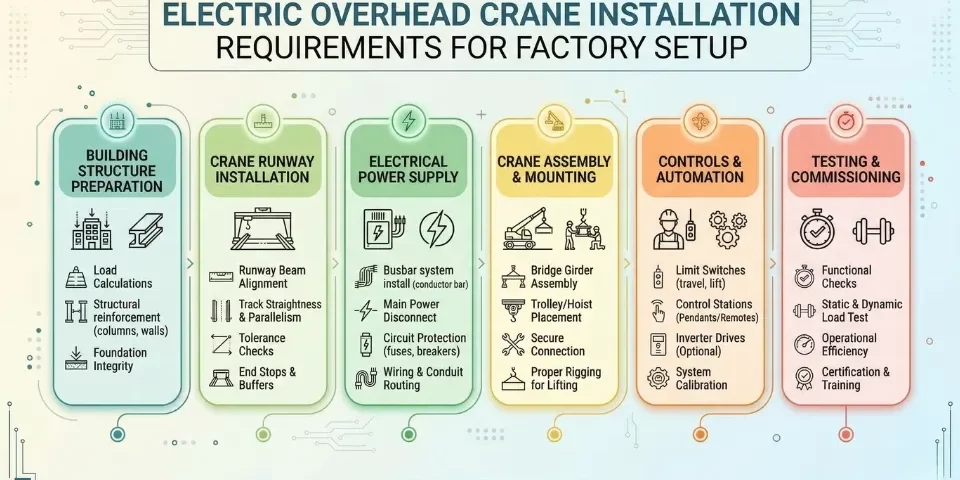
Step-by-Step Crane Installation Process
A professional crane installation typically follows these steps:
Step 1 – Structural Inspection
Engineers inspect the building structure.
Step 2 – Runway Beam Installation
Steel beams are installed and aligned.
Step 3 – Rail Alignment
Crane rails are placed precisely.
Step 4 – Crane Assembly
Crane components are assembled.
Step 5 – Electrical Wiring
Power supply and control panels are installed.
Step 6 – Load Testing
The crane undergoes load testing to verify performance.
Each step ensures compliance with Electric Overhead Crane installation requirements.
Common Mistakes During Crane Installation
Many factories face problems due to poor installation practices.
Common mistakes include:
-
Weak runway beams
-
Incorrect rail alignment
-
Poor electrical grounding
-
Insufficient headroom
-
Lack of safety devices
Avoiding these mistakes ensures proper Electric Overhead Crane installation requirements.
Cost of Crane Installation in India
Installation costs vary depending on crane capacity and complexity.
Typical installation costs:
| Crane Capacity | Installation Cost |
|---|---|
| 5 Ton Crane | ₹50,000 – ₹1,00,000 |
| 10 Ton Crane | ₹1,00,000 – ₹2,00,000 |
| 20 Ton Crane | ₹2,00,000 – ₹4,00,000 |
Installation cost is a significant factor when planning Electric Overhead Crane installation requirements.
Future Trends in Crane Installation
Modern industries are moving toward smart crane systems.
Emerging technologies include:
-
Smart sensors
-
IoT monitoring
-
Predictive maintenance
-
AI-based load control
These technologies will reshape future Electric Overhead Crane installation requirements.
Conclusion
Installing an industrial crane requires detailed planning, structural preparation, electrical infrastructure, and safety compliance.
Understanding the Electric Overhead Crane installation requirements helps industries avoid operational issues and ensures long-term performance.
From structural design and electrical setup to safety devices and compliance standards, every factor must be considered before installation.
When planned correctly, electric cranes can significantly improve productivity, reduce manual labor, and enhance workplace safety.